
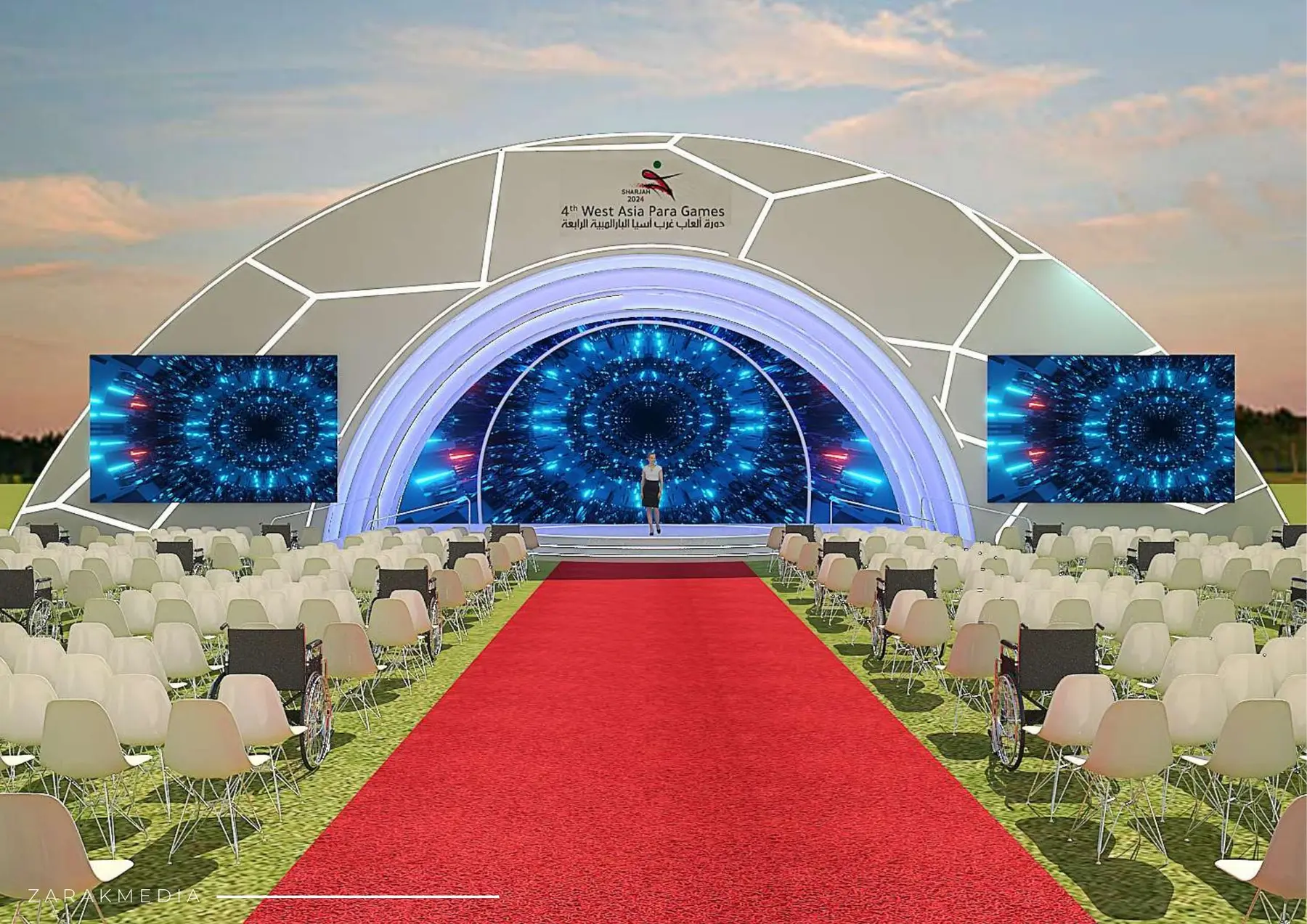
The best exhibition stand design ideas in Dubai are rarely the flashiest. They are the ones that make a visitor understand you in three seconds, give them a reason to stop, and somewhere to talk once they do. A giant screen or a double-decker can help, but only in service of that. These are the ideas that actually pull a crowd at a busy show, grouped from the cheapest to the most ambitious.
Start with one bold, readable idea
The most common mistake is trying to say everything. A stand that lists ten messages says nothing. Lead with one idea, large and legible, that a visitor can read from across the aisle while walking. Your detailed story can live in the conversation that follows; the stand's first job is to earn that conversation. At the scale of shows like GITEX or Gulfood, where hundreds of stands compete, this clarity is the single biggest advantage you can design in.

Make the message readable from the aisle
Design for the walking visitor, not the standing one. Headlines belong high and large, where they clear the heads of people in front of the stand. Keep body text short and few. Use contrast so the words read under harsh hall lighting, and leave space around them; a crowded graphic is as hard to read as small type. A good test: stand ten metres away and see whether you still know what the brand does.
Lighting: the cheapest upgrade that changes everything
If you change one thing, change the lighting. Good lighting lifts materials, makes graphics pop and signals quality before a visitor reads a word. Spotlights on the product, a warm wash on the meeting area and a bright, even light on the headline will do more for most stands than another screen or more structure. It is inexpensive relative to its effect, and it is the lever we reach for first when a stand needs to feel more finished.
Give people a reason to stop
Traffic walks past walls of logos. It stops for something happening. The strongest stands build in a reason to pause: a live demonstration, a working product people can touch, a short interactive experience, a small talk or, honestly, good coffee and a seat. The idea does not need to be expensive; it needs to be genuine and easy to join. Once someone stops, the stand's layout should make it natural to stay and talk.

Open or enclosed: design the kind of traffic you want
Openness is a design decision, not a default. An open stand with clear sightlines invites walk-up traffic and suits lead generation and product display. A more enclosed stand creates focus for private meetings, demos that need quiet, or hospitality. Most effective stands combine the two: an open, inviting front that draws people in, and a calmer area behind for the conversations that matter. Decide which behaviour you want before you draw the layout.
Use height and verticality
In a flat hall of similar-height stands, going up helps people find you. A tall branded element, a raised sign where the venue allows rigging, or a double-height feature creates a landmark that visitors navigate towards. On larger stands, a second storey turns height into usable space for meetings or hospitality, though it brings engineering and approvals; we cover that trade-off in our guide to custom, modular and double-decker stands.
Materials, finish and designing for reuse
Materials carry a surprising amount of a stand's impression. A considered mix of timber, fabric, metal and good flooring reads as quality, while cheap laminate and tired carpet undercut even a clever design. If you exhibit more than once a year, choose materials and a structure you can reuse: a durable modular core with graphics you refresh each show looks new every time without a new build. It is better for the budget and it wastes less.
Technology, used well
Screens and interactive technology are powerful when they do a job and distracting when they do not. An LED wall that runs a live demo, a touchscreen that configures a product, or a simple screen that shows the thing your visitor cannot see in person all earn their place. A wall of video playing to no one does not. Decide what the technology is for, who will staff it, and what you want a visitor to do with it, before you budget for it.
Layout and flow: guide the visitor
A stand's layout quietly decides how people move through it. Put the thing that draws attention at the edge where traffic passes, and the thing that needs focus, a demo or a meeting, deeper in where it is calmer. Leave clear ways in and out so the stand never feels like a trap, and keep the busy, noisy activity away from the quiet conversations so neither spoils the other. A counter or host near the front, positioned to greet rather than block, gives passing visitors a natural first point of contact. Design the journey from aisle to conversation, not just the look of the walls.
Do not forget the people on the stand
The best-designed stand underperforms if the team on it is not ready. A stand is a setting for conversations, so design for the staff as much as the structure: a clear place to greet people, somewhere to have a longer talk, and space to store bags, water and collateral out of sight. Brief the team on the one message and the one action you want from a visitor, and make sure the layout supports that rather than fighting it. The human welcome is part of the design, and it is the part visitors remember.
Sustainability: stands that do not end in a skip
More Dubai exhibitors now want a stand that is not thrown away after three days, and organisers increasingly encourage it. Designing for reuse, choosing a modular core, durable materials and reprintable graphics, is the most practical form of sustainability, because it cuts both waste and cost. Where elements are one-off, favour materials that can be recycled rather than sent to landfill, and keep the structure simple enough to pack, store and rebuild. A stand designed to live for several shows is usually the greener and the cheaper choice at once.
Ideas by budget
| Budget | Highest-impact ideas |
|---|---|
| Lean | One clear headline, strong lighting, a tidy layout, one reason to stop |
| Mid | Custom-looking modular build, a feature wall, a meeting area, one screen with real content |
| Flagship | Bespoke structure, height or a second storey, an LED feature and a live demo or experience |
Bringing it together
A stand that works is not a collection of features; it is one clear idea, well lit, with a reason to stop and a place to talk, built from materials that read as quality. Start from what you want a visitor to do, design backwards from that, and add technology and scale only where they serve it.
When you are ready to turn ideas into a build, see what an exhibition stand costs in Dubai to set the budget, and our exhibition stand design and build page for how we take a concept from sketch to install.
No comments yet.